Yesstea: A Refined Script Handwritten Font for Elegant Branding
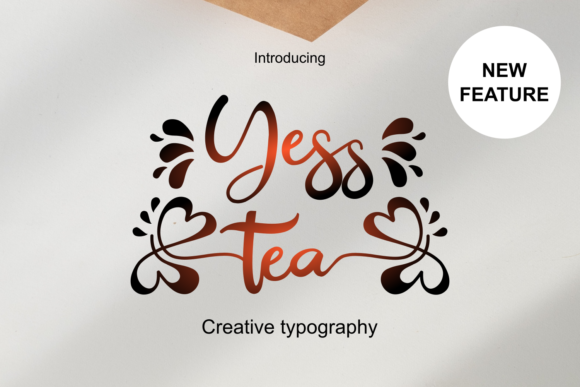
There’s something quietly thrilling about opening a fresh brand board and dropping in a new script font—especially one that feels like it was made for the project you’re holding in your mind. That’s exactly how I felt when I first tested Yesstea on a visual identity for a small, locally owned apothecary-style skincare studio. The client wanted warmth, authenticity, and quiet luxury—not flashy or trendy, but timeless. And right away, Yesstea delivered: a chic, refined script font that emanates sophistication and elegance without leaning into cliché or over-decoration.
Yesstea for Logo Design and Signature Brand Marks
I started with the logo lockup—testing Yesstea as the primary wordmark. Its smooth, confident strokes flow like ink on handmade paper, and because it’s a Script Handwritten typeface built for intentionality, it never reads as generic or AI-generated. The PUA encoding meant I could access stylistic alternates and ligatures instantly in Illustrator—swapping out a standard “&” for a graceful, custom-connected version, or choosing between two distinct lowercase “a” forms to match the tone of each word. As a Fonts choice for logos, Yesstea works best at medium-to-large sizes: think shop signage, business cards, and letterhead headers. It’s not meant for body copy—but as a display font? Absolutely magnetic.
Yesstea for Product Labels and Minimalist Packaging Design
For the skincare line, we needed labels that felt tactile and intentional—think matte kraft stickers, soft-touch foil stamping on glass serum bottles, and embossed cotton pouches. Yesstea held up beautifully across all those surfaces. Its subtle contrast and open letterforms kept readability high even at 10–12pt on curved label wraps. Because it’s a Script Handwritten font with elegant rhythm—not tight, not cramped—it gave the packaging breathing room while still feeling personal. I paired it with a warm, low-contrast serif (think Adobe Garamond or EB Garamond) for ingredient lists and care instructions: Yesstea as voice, the serif as quiet authority. That pairing reinforced hierarchy without sacrificing cohesion.
Yesstea for Social Media Graphics and Digital Brand Consistency
Instagram posts were where Yesstea really surprised me—not just in aesthetics, but in performance. When used sparingly (a single headline phrase overlaid on a neutral background), it added instant warmth and human texture to otherwise clean, minimalist feed aesthetics. Unlike many script fonts that blur or pixelate on mobile screens, Yesstea’s clean vector outlines stayed crisp at any size. And because it’s PUA encoded, I could pull alternate glyphs directly into Canva and Figma using the glyph panel—no workarounds, no font substitution. For designers who build social templates for clients, that reliability matters. Yesstea isn’t just another decorative Fonts option; it’s a working tool for consistent digital expression.
Yesstea for Wedding Invitations and Elegant Branding
While the apothecary project was my first deep dive, I’ve since used Yesstea on two wedding stationery suites—and each time, it elevated the entire mood. Its ligatures (like the seamless “Th”, “Fl”, and “St”) create subtle moments of connection that feel hand-lettered but perfectly controlled. As a Script Handwritten font, it avoids the wobbly unpredictability of true handwriting while keeping soul and gesture intact. Clients noticed immediately: “It feels like it was written just for us.” That emotional resonance is rare—and valuable. Whether printed on cotton rag paper or set as web typography in a Squarespace header, Yesstea communicates care, curation, and calm confidence.
Yesstea for Editorial Design and Print Collateral
We extended the apothecary’s identity into a seasonal lookbook—16 pages, uncoated stock, full-bleed botanical photography. Here, Yesstea shined as a headline font and section divider. Used at 24–36pt in tight leading, its elegance grounded each spread without competing with imagery. I avoided setting more than one line in Yesstea per spread—keeping it purposeful—but those lines carried weight. For body text, I paired it with a friendly, slightly rounded sans serif (like Suisse Int’l or Manrope), letting Yesstea act as punctuation, not prose. As a Fonts solution for editorial design, it proves that script doesn’t have to mean “fussy”—it can be functional, intentional, and deeply atmospheric.
Yesstea for Business Cards, Shop Signs, and Physical Brand Touchpoints
The real test came when we mocked up the storefront sign. Would Yesstea read clearly from six feet away? Yes—but only when sized thoughtfully and spaced with generous tracking. Its refined structure gives it presence, and its open counters prevent visual crowding. On the business card, we used a single-line tagline in Yesstea, centered beneath the sans serif name—just enough flourish to signal craftsmanship, not clutter. That balance is why Yesstea stands out among Script Handwritten fonts: it’s expressive without being exhausting, delicate without being fragile.
How to Test Yesstea Before Committing to a Full Brand System
Before locking in Yesstea across all assets, I always run three quick checks: (1) Does it hold up in black-on-white at 14pt on a product label mockup? (2) Does a single line in a website hero banner feel balanced—not too light, not too heavy? (3) Do at least three ligatures or alternates genuinely improve the phrase I’m typesetting? If yes to all three, it’s ready. And because Yesstea is PUA encoded, testing is frictionless—you don’t need special software or workarounds to explore its full range. Just open the glyph panel and play.
If you’re building a brand that values sincerity, subtlety, and craft—whether for a boutique, studio, café, or handmade line—Yesstea is more than a Fonts download. It’s a thoughtful, reliable, and quietly powerful Script Handwritten typeface that earns its place in your design toolkit.